The “16 Days” campaign – online violence: stalking, harassment, hate speech
26 11 2025
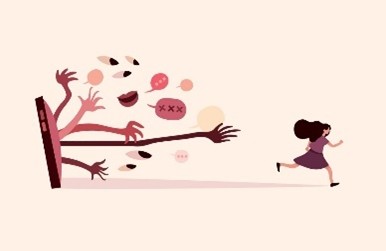
Online violence takes many forms – from persistent stalking (cyberstalking), to harassment and sending offensive content, to online hate campaigns. The phenomenon is growing rapidly with the development and growth of social media, so it is worth familiarising yourself with the terms that describe online violence.
Stalking is the persistent harassment of another person or a person close to that person, which makes that person feel threatened, humiliated or anguished or which significantly invades his or her privacy – this can include following social media profiles, collecting information, sending unwanted messages, making threats or publishing private data.
Harassment consists of persistent, hostile behaviour that causes the victim to feel afraid, threatened or humiliated; on the internet it most often takes the form of mass messages, repetitive comments or stalking on forums and groups.
Hate speech is content that insults, demeans or calls for violence against individuals or groups because of their legally protected characteristics, such as gender, sexual orientation, gender identity, ethnicity, race, religion or disability. Its purpose is discrimination and exclusion.
The Campaign for supporting dialogue and countering hate speech on the University of Warsaw teaches how to recognise and respond to hate speech, take care of the culture of words online and in real life. It enables each of us to contribute to creating a safe and respectful space for diversity.
Women, young people and people belonging to minority groups are particularly vulnerable to such attacks, and the scale of the phenomenon is increasing with the prevalence of social media and communication tools [1]. According to EIGE research, as many as 1 in 2 young women in the EU report having been the target of offensive or aggressive online content, often of a sexist nature [2], 58% of teenage girls have been exposed to online heckling and 30% have experienced direct online harassment [3]. Although perpetrators often act seemingly anonymously and online violence is sometimes downplayed, its effects are real: they take away a sense of security, lead to anxiety, depression, and dropping out of professional or academic activities.
Although online violence seems “invisible”, many forms of it constitute a criminal act. In Polish law, stalking, is an offence under Article 190a of the Penal Code, punishable by up to three years’ imprisonment. Publishing threats in messages, comments or social media is criminalised under Article 190 of the Penal Code. Insults in online spaces (e.g. in comments) are prosecuted under Article 216 of the Penal Code, and directing content inciting violence on the basis of gender may fall under Articles 119 of the Penal Code and 257 of the Penal Code, concerning hate crimes.
How to react? First: document – record the content, take screenshots and collect evidence that will help with possible reporting. Second: use the mechanisms for blocking and reporting abuse on social media platforms. Third: report incidents to relevant university units and support organisations. In situations of immediate danger, contact the police.
Those words and actions that are illegal in the real world are also punished if someone commits them online.
—————————————————————————
We would like to remind you of reliable sources of information and places where you can find help:
Feminoteka Foundation supporting women experiencing violence, providing free legal, psychological and therapeutic assistance
Feminoteka Foundation women’s helpline 888 88 33 88 free, confidential and professional help offered by Feminoteka Foundation experts to women who have experienced violence
Women’s Rights Centre support for women whose rights are violated, in particular women experiencing violence, free psychological, legal and social assistance, civic and professional advice
Blue line number 800 120 002 free and confidential support of the Polish National Referral Service for Victims of Family Violence “Blue Line”.
Help map – an interactive map of Poland, containing information about places where women can obtain legal, psychological, social support or accommodation, created by the Czas Kobiet Foundation
Information on support institutions at the University of Warsaw can be found here.
——————————————————————–
[1] https://www.unfpa.org/bodyright
[2] European Institute for Gender Equality, Cyber violence against women and girls., European Union Publications Office, 2022, https://eige.europa.eu/publications/cyber-violence-against-women-and-girls
[3] NASK, Teenagers 3.0. Research report, NASK National Research Institute, 2023.
[4] Act of 6 June 1997. – Penal Code (Dz.U. 1997 no. 88 item 553 as amended).
Definitions prepared on the basis of the Act of 6 June 1997. – Penal Code (Journal of Laws 1997 no. 88 item 553 as amended)